As I mentioned in my last post, CB got a job. We have started and ended house-hunting, and, for those of you crossing your fingers for me, I got a great kitchen and a yarn room that I don't have to share (except with this spoiled rotten little gem).
Until we move in, I'm basically chronicling thoughts and meals, which, admittedly, isn't the most interesting way to keep a food blog. Every time I think about getting into creative mode in the kitchen, I'm confronted with the idea that this is not-my-kitchen and these are not-my-things. So, back to CB got a job, and we looked at houses.
The day that he found out he had gotten the job, I decided he needed a little something of recognition. I spoil him, I do. I secretly arranged with the woman who made our wedding cake to make a tiny congratulations cake for him. The best part of her cakes is that not only are they tasty, but they have little clay figurines on top. I dare say more people commented on how good our little figures looked on the big day than commented on how good we looked!
The reason I mention the cake, besides just being very tickled by it, is that The Little Cupcake Cafe is one of the few places in Belfast to get a decent gluten-free treat. I had already arranged with CB's mother to help me pick up the cake, but it was turning into a logistical nightmare to try to get it without him knowing. Thus, the little white cupcake lie.
Ah, yes, the sunny days of house-hunting. While the rain was holding off, we decided a constructive use of our time was to simply take a taxi to a nice neighbourhood and walk until our feet fell off. We made notes of real estate agencies and houses that looked pleasant. We walked, got a little sunburned, and ended up with just about nothing once we looked up the prices. We kept fairly good moods, considering the poor luck we were having.
Until Cake Day.
We were well across town from the shop, and I declared that I wanted a cupcake. An hour later, it escalated to my needing a cupcake. Another hour and CB was simply refusing me a cupcake. Never mind that we were too far away for either of us to do anything about it. By the end of our house search, I said that I was going to get a cupcake because his mother wouldn't like to hear of his refusing me a simple pleasure; she would surely drive me to get one. She played along brilliantly, feigning exasperation at her son and immediately driving to the only shop which could provide me with what I wanted.
We sat down for a cup of tea and a cupcake. Cathy, the fondant artiste, silently showed me the cake and placed it behind the till. I managed to signal to the girl working the counter that I was to pay for the cake while asking for a glass of water; she casually slipped my change on the counter and walked away, enjoying the bit of espionage.
As we were standing to leave, I said to CB, "That box behind the till says 'Burke'. Do you think it's for us?"
CB: "Burke is a common name. I'm sure it's not."
Me: "But it could be?"
CB's Mum: "Did you buy Sydney a box of cupcakes?!"
CB: "No, let's leave." (getting a bit embarrassed by now)
I peek behind the till. "But, it has MY name on it."
CB: "Sure it does."
I am handed the box. "Look, it does!" I open the box and all is revealed. I thought he was going to hit the floor with shock. After he eyes up the little figure of himself, I add: "I didn't even want a cupcake."
Less sneaky but equally as exciting (for me. Only me.) was the idea of eating on our short trip to Dublin. As a thank you present for helping him with the application and interview preparation for his job (and probably for constantly stating how much I believe in him), CB bought two tickets to see Oscar Wilde's A Woman of No Importance in the Gate Theatre in Dublin. [Go! See it! Bring a wee hand fan because it is boiling inside!] We already had our mind set on where to eat dinner before the show, but we still had an opening for lunch the next day. CB sent me a link with gluten-free possibilities to browse, and there it was. The restaurant that had managed to slip my mind that I used to obsess over visiting.
Cornucopia.
It was somehow a hundred times better than I even imagined it. We got there just before the major lunch crowd, so we got a table just as we got our food. By crowd I mean that the queue was completely out the door, and people were sharing every little corner of tables just to be able to eat. The menu is a set of blackboards behind the counter. Not everything is gluten-free, but everything is vegetarian. There was a legend hanging above the blackboard explaining what was egg-free, gluten-free, nut-free, chili-free, vegan, etc. It truly felt empowering not to have to ask what was in something before I ordered. I am aware that that last statement will sound completely alien to anyone without dietary restrictions, but I felt like I owned the place when I ordered my food.
THIS was the amazing, empowered meal I had. Curry and rice with sweet potato, carrot, chickpea, fine beans, and broccoli; kidney bean, tofu, and rocket salad; and a garlic and almond potato salad. 100% vegan, 100% gluten-free, 100% giddy-inducing. Eat there. Just do it.
Friday, August 24, 2012
Wednesday, August 8, 2012
Don't let them get you down
The title of this post is directed, mainly, at myself. I'm reminded everyday that I have an issue, a condition, something that makes me different. It's not presented as a particularly negative thing, but I can't help but sometimes internalise it as such.
My husband CB and I are in a transitional period. For a while, we weren't sure which side of the ocean we would be calling home. The lease on our house was up in July, there was one more job over here that wouldn't be decided until August, and, well, visas take a while to process. Short term leases are really only available on efficiency apartments or really poorly everything-ed student houses. So, we've been living in CB's parents' house for the past month. They have been gracious and welcoming, but then there's the food thing. As they want to be accommodating, and the family dinner is often a big deal, I'm forever hearing, "Can you eat this?", "Where is good for you?", "Which is better: X or Y?". I know that every one of those sentences means they are trying, they are considering me, and they are not just leaving me to fend for myself, but I can't help but remember that, in our own house, it was simply a given. I can eat this, I can't eat that. It wasn't really discussed unless it was in a positive way: "Guess what I just learned I can eat!"
CB got the job -- which I'm convinced was the only job left in Northern Ireland -- so we begin our house hunting today. Visas get put off a while longer. I get to start planning my new kitchen.
I can't say that my time in this house has been without inspiration. I'm referring to the Olympics but trying to steer clear of being just another blogger talking about the Olympics. I've been learning (and educating) about athletes that are Celiac/gluten-intolerant. Novak Djokovic, the Serbian tennis player who failed to place in these Olympics but won Wimbledon in 2011, has a gluten intolerance. In fact, he credits his Wimbledon title to this discovery, as he was able to train longer, harder, and faster once he omitted gluten from his diet. Jenn Suhr, Gold medalist in the pole vault for the USA, tested positive for Celiac Disease only last year. She was finding it difficult to maintain her strength in training sessions and would even put off eating solid foods until after the training day was done. She eliminated the gluten and brought home a gold medal this year.
What I'm not saying is that not eating gluten will take you to the Olympics. What I am saying is that, even with a condition that can be so depressing and something that factors into your daily life, you can excel to whatever level is appropriate for you. I need to lose all this weight from my medical ups and downs (mostly downs) last year, but I've often allowed lethargy and stomach pain stop me from pushing myself. But, I'm going to do it. I've got the swimsuit hanging in the wardrobe. I brought my tennis racket over from where it sat, dusty, in my parents' house in America. I'm going to do it.
I might just leave the pole vaulting to Suhr, though.
Labels:
athletes,
Celiac,
dietary restrictions,
Djokovic,
gluten,
gluten-free,
Ireland,
Olympics,
Suhr
Thursday, July 26, 2012
Brava, Sligo!
When I decided -- with my husband and his family -- to go on a weeklong holiday in the west of Ireland, I honestly wasn't sure if I would end up starving to death while we were gone. After all, "gluten" seems like such a foreign word in rural places, and let's just forget about "Celiac"!
To my extremely pleasant surprise, it turns out that Sligo, Ireland is a Mecca for Celiacs. I was even able to do something that is a no-go in the big city of Belfast -- eat breakfast in a restaurant! I'm so happy that my favourite little town in the world is able to cater for my particular needs so well.
It appears that the reason Sligo is so Celiac-friendly is because of the hospital in town. In 2010, they began testing and trials based around Celiac (Coeliac) and Hemochromotosis ("iron-overload"). Apparently, the incidence of Celiac diagnosis in northwest Ireland is very high, and gluten-related investigations in Sligo's hospital sit at about 2,000 cases per year. That number is extremely high when considering Sligo is a very small place. Sligo now has the technology to perform Celiac testing in house, rather than sending the materials to Dublin for processing.
I was previously in Sligo in 2008. Though I can honestly say that I wasn't looking for gluten-free options in restaurants, I do know that nothing caught my attention back then. (Having many restrictions on my diets, I tend to pick up on available options and the fine print that says to ask your waiter if you have any allergies even if they do not relate to me.) I can only assume that the more the community learns about Celiac, the more likely they are to provide options for their own citizens and vistors.
The following is only a guide. Since a lot of the information I found before heading to Sligo was quite old, I thought I would offer an updated account of what I found. It's not exhaustive -- I didn't go door-to-door, restaurant-to-restaurant (though it does sometimes feel like what I do!). These are the places I discovered. [Note: Everything food-related in Sligo seemed to be a bit pricey. I was tempted to say that about all the restaurants.]
Bistro Bianconi, Tobergal Lane, Sligo town
I think we ended up eating here three times over the week. Pizza, pasta, etc. It's a nice sit-down restaurant, but it doesn't require dressing up. Everything we tried was great, gluten-free or not. They have gluten-free pizza bases and pastas. They don't charge more for them, and they don't look at you funny when you order. The four course early-bird menu wasn't entirely Celiac-friendly (soup, Caesar salad, garlic bread for starters), but the regular menu is always available. Their ice cream was gluten-free, and they had a lovely pavalova on for the dessert of the day once.
Osta Cafe, Garavogue Weir, Sligo town
Ok, I'll admit it. I ate their pancakes on four different occasions. But, in my defense, they have several different options! While there are not a ton of gluten-free choices on their menu, a simple breakfast is well-handled. There are scones (I had a plain one with jam and butter.) and muffins (Mine was raspberry and coconut.) baked every morning. Gluten-free pancakes come with the following options: lemon, butter, and sugar; cinnamon-infused berry compote and greek yoghurt (seen half-eaten above); local honey, greek yoghurt, and sliced almonds; bacon and maple syrup . . . and I'm pretty sure I'm missing something.
Bella Vista, Shore Road, Strandhill
Strandhill was a beautiful little place not far from Sligo town. It's famous for its surfing (no swimming allowed), but the view is amazing. Of course, everything on the west coast is the Atlantic Ocean, but you really feel like you're looking out into the ocean from Strandhill. As far as I can tell, all the businesses in Strandhill are on one road -- Shore Road. We passed by a couple of restaurants where I could have eaten (a lot of Asian cuisine is safe if you know what to look for), but we stopped at Bella Vista because there were a lot of options. I think the place is a bit under-staffed, but hopefully that was only a temporary problem. They also charge €2 for changing a pasta or a pizza base to gluten-free. I ordered tagiatelle a la pollo. It turned out that they had actually run out of gluten-free tagiatelle, and the waitress was too busy to ask me if substituting spaghetti was okay until it was being presented to me. Of course, I was fine with it, but why bother asking if they had already made the decision? My husband, CB, would like to point out that you should discourage anyone non-gluten-free in your party from getting the steak sandwich. Everything else was good.
The Yeats Tavern, Drumcliffe
The Yeats Tavern is just down the road for where W.B. Yeats (and his wife! Don't forget his wife!) is buried. Otherwise, it seems to have nothing to do with the poet. Regardless, I had a very decadent meal here. It started simply enough -- their vegetable soup is gluten-free, and they have a lovely note just under it on the menu that says "Ask your server for gluten-free bread!". And, what a lovely piece of bread it was! My main course was a special of pan-fried chicken smothered in roasted peppers and covered in a thick slice of goats cheese, which was baked to form a crust. It was drizzled with balsamic vinegar and pesto. It also came with a choice of potatoes -- the dinner menu does not mention that the chips are not gluten-free, but I noticed it on the early-bird menu posted at the entrance -- where I chose the buttered new potatoes and stole a few sneaky bites of CB's garlic and cheese au gratin (we checked on their Celiac status!). For dessert, they have gluten-free ice cream, around which they formed several options, and a chocolate brownie with a "gluten-free alternative". I didn't find out what that alternative was because I opted for an ice cream dish with bananas and toffee -- surprisingly light and refreshing!
Poppadom, O'Connell Street, Sligo town (no website)
Considering my love for Indian food, I knew I would be visiting this restaurant again after a positive experience four years ago. It did not disappoint (except that CB wanted Peshawari naan and did not find it on the menu -- he got on just fine with his regular naan). I always find myself customising my meal in Indian restaurants as of late, and they were more than happy to provide exactly what I wanted. We were confused that there was a tasty chicken option on the early-bird menu (which we missed) that wasn't on the main menu, though I can't remember what exactly it was. Best yet was that, after a warm and muggy day, they had an air conditioner! I know, I know: I'm a spoiled American and my husband is an over-warm Irishman, but we like our cool air.
Tesco store, O'Connell Street, Sligo town
This entry is the one real oddball on my list because it is not a restaurant. However, I can't speak on my time eating in Sligo without mentioning shopping at Tesco. They had a great selection of gluten-free flours (even Bob's Red Mill!), mixes, sauces, breads, and other food-stuffs. I found things I haven't been able to find anywhere up North. In fact, we indulged a bit on some sourdough bread (well-sealed) and a box of deep-pan pizza bases to bring back home with us! There were some mini baguettes from a gluten-free bakery in Cork (who knew?!) that made for great sandwiches for the days' adventures (believe it or not, we did more than eat!).
And, in case you were wondering why I'm so shocked at the gluten-free selection, this was the view from our bedroom window every morning!
Labels:
breakfast,
Celiac,
dietary restrictions,
gluten-free,
Ireland,
restaurants,
Sligo,
travel
Location:
Sligo, Co. Sligo, Ireland
Wednesday, May 30, 2012
Oatmeal raisin wonderfulness
I know I've said it a hundred times, but recipes that are already gluten-free are so much nicer. This Christmas, I treated myself to a Babycakes (look how lovely!) cookbook, and I'm finally getting the chance to put it to use. And, now I have a new favourite dessert.
I made her recipe for oatmeal cookies and crumbled one (and a half, shh) into a bit of greek yogurt. It was a beautiful combination.
The recipe calls for Bob's Red Mill products, and I definitely suggest you use them. There are a lot of other gluten-free products on the market, but Bob's is reliable and makes a great mix of baking flours. Whenever possible, I buy their flours. I even found my first Bob's flour in Belfast today -- oat flour -- and I'm going back to buy a bunch of it tomorrow!
So, here is the Babycakes recipe for the cookies. I hope you try it, love it, and run out and buy the book for yourself.
Ingredients:
1 3/4 cup Bob’s Red Mill All Purpose Gluten-Free Baking Flour
1 cup [vegan] sugar
1/2 cup Bob’s Red Mill Gluten free oats
1/4 cup ground flax meal
2 tablespoon cinnamon
1 1 /2 teaspoon xanthan gum
1 teaspoon baking soda
1 teaspoon salt
1 cup melted coconut oil
1/2 cup unsweetened applesauce
2 tablespoon vanilla extract
3/4 cup raisins
Hardware:
measuring cups and spoons
mixing bowl
parchment paper
baking sheet
whisk
spatula
oven
Directions:
Preheat oven to 325°F/160°C. Line a baking sheet with parchment paper.
In a medium bowl, whisk together the flour, sugar, oats, flax meal, cinnamon, xanthan gum, baking soda, and salt. Add the melted coconut oil, applesauce, and vanilla stirring with a spatula. Add the raisins and stir until combined.
Bake for 8 minutes. Rotate the baking sheet and bake for another 7 minutes. Allow the cookies to cool on the parchment for 15 minutes.
Labels:
Bob's Red Mill,
cinnamon,
desserts,
dietary restrictions,
gluten-free,
oats,
vegan
Sunday, May 27, 2012
Gluten-free facts
There is a ton of information out there on Celiac Disease, but it's not always accessible, understandable, or without judgment. And it really shouldn't be that way. Some people have mild discomfort and are looking for ways to improve their life. Others may have been dancing around the idea of gluten issues or Celiac for a while now. So, here are my top ten thoughts that I hope can help you make your own decisions.
1. Not everyone who problems with gluten have Celiac. Some people have gluten intolerance or gluten sensitivity. Just because you have a Celiac blood test come back negative does not mean that it's all in your head.
2. While there are tell-tale signs, not everyone experiences Celiac the same way. Both men and women can have swelling that makes them look really pregnant, but that could also be from IBS (which often goes hand-in-hand with Celiac and gluten intolerance and from which I also suffer).
3. The only way to be 100% sure you have Celiac is through blood tests or, preferably, biopsy of your gut. The biopsies are invasive and can sometimes be painful, but they are performed with an endoscopy (camera down your throat and into your stomach and gut) and under general anesthesia. Your body has the amazing ability to repair itself internally extremely quickly, assuming you are in otherwise good health. The wounds from the biopsy should heal completely within 48 hours. You likely will not notice them on top of your other symptoms.
4. The downside of the blood test or biopsy: If you have already determined you have a problem with gluten and stopped eating it, the tests will come back negative. There is only the possibility for a positive result if you have been eating gluten for 4-6 weeks before the test. If you've ever had a gluten accident or had to eat gluten for a health test (I did for a heart monitor), you will likely say that it's not worth it to get the diagnosis when you already know you have a problem.
5. People do take the term "Celiac" more seriously than "gluten intolerance" or "gluten sensitivity". Be aware that, if you choose not to take the Celiac test because you don't want to eat gluten, it will make a difference in how some people treat you.
6. Read every label. You would not believe the stuff gluten is in. Check ingredients lists, and check them often. Recipes change all the time. Doritos in the UK used to be gluten-free but no more. Lindt chocolates are now made with barley malt, which contains gluten.
7. You would be much better off making your own sauces and spice mixes at home (or at least buy from a handmade shop -- the extra cost is worth it in this case because it's fresh and you can ask exactly what's in it.). Gluten can be used as a stabiliser in these products. It thickens sauces and gravies. It keeps spice mixes from separating into layers or clumping because it will absorb moisture quicker than the rest of it.
8. Celiac or not, corn isn't good for you. It is hard for all people to digest, and it's particularly hard for people with gluten problems. It doesn't make much sense because there isn't gluten in it. What I do know is that corn is a grain, and humans have found a way to eat it as a vegetable instead. It was never intended to be eaten on the cob, by the kernel, or popped in oil and air. We can't digest it. However, cornmeal and cornflour are often used as substitutions for wheat flour. It isn't as bad for you when ground up into these forms, but it still isn't digested as easily as other flours. Just be careful.
9. If you are diagnosed with Celiac, it's in your best interest to invest in some bigger clothing. It's not that I'm saying you will gain weight -- you may as you find your way in this new life -- but you will have "fat days". It's not fun, and it's not comfortable. You don't necessarily need an entire new wardrobe, but get yourself some new house clothes, a pair of bigger jeans, a few t-shirts or whatever tops you wear on casual days, two professional outfits (if you have need for them in your life or line of work), and two formal event outfits. It sounds like a lot, but when you have a gluten accident (I refer to it as "being glutened".) or simply have a stressful couple of days, you'll feel a lot better having clothes that fit rather than trying to squeeze into clothes that will only make you more sad, tired, and stressed out. Emotions run high on these fat days because your body will be spending most of its energy working through issues in your gut.
10. It's not easy. Take it day by day. While you should never undertake a diet that fully eliminates a vast amount of food without extensive research and/or doctor consultation, it's not going to hurt to try. Anyone can go two weeks without something. If you have a problem with gluten, you'll know. You'll probably know sooner than that. It took me two days to know. It's likely I'd gone two days many times in my life without gluten, but I probably just thought that they were good days without thinking about what I'd eaten. If you do not have a true problem with gluten digestion, I cannot recommend going completely gluten-free. I would love to have a gluten-free home, but I know it is not healthy for my husband, and it won't be healthy for my children if they don't inherit the Celiac. There are some people who could be considered "Lifestyle Celiacs", but I don't think it's a good idea. However, if it makes you feel better, give it a chance. Talk to your doctor or a nutritionist. Find out. It may seem like Celiac and gluten problems are the fad of the moment, but it's mainly due to the fact that a lot of people are only finding out that wheat can even cause problems, as well as the Lifestyle Celiacs (Lifestyle ANYTHINGS tend to be very vocal, which I can't say is always a problem since it can increase awareness for those who genuinely have issues). Celiac is not a fad. It is not a fraud. And, it is not something you can ignore if you have it. Every day that you continue eating gluten damages your body.
Bonus: Let those you care about know what's going on. You don't have to tell them everything that's happening in your bowel habits and everything you've eaten that causes issues, but tell them you have a digestive problem and have to be careful. It makes eating at restaurants and friends' houses easier, and you don't have to pre-apologise on every bad day. Take credit for your bad actions -- it's not an excuse, but a reason -- but those you care about will understand that things are tough sometimes. Be honest, and they will help.
Labels:
Celiac,
convenience,
dietary restrictions,
gluten,
gluten-free,
substitutions
Thursday, May 24, 2012
When in Belfast . . .
When in Belfast . . . and you get one of the two weeks with warm and sunny weather . . . do as the Irish do -- "barbecue". The term "barbecue", here, refers to anything that is put over a fire. It does not require any specific sauces or any particular lawn ornaments. It just means you go outside and eat your food.
This weather is called "exam weather" by most people. Belfast experiences two guaranteed weeks of lovely weather each year, the first as schoolboys and -girls sit their year-ending exams. The idea is that they spend hours staring at essays and standardized tests only to glance up at the sun streaming in the windows. The second week is just as school resumes in the autumn. The new school term generally brings with it the winter uniform (wool blazers and long socks) and another sunny, warm week. The apathy of the new syllabi and reading lists is met with even more sunshine. In short, it is cruel.
However, not being a schoolchild and not currently facing a near deadline of any sort means that I can take advantage of the weather. I am not -- by ANY stretch of the imagination -- an outdoors person, but I relish in these days, mostly because it is dry rather than warm.
Today, on a bit of a whim, I bought a mini disposable barbecue. It amounted to an aluminum casserole tray, a bit of charcoal packaged in paper, and a thin grate. We procured my husband some German smoked sausages and mini finger rolls, a chicken breast for myself, and the makings of a wee cookout.
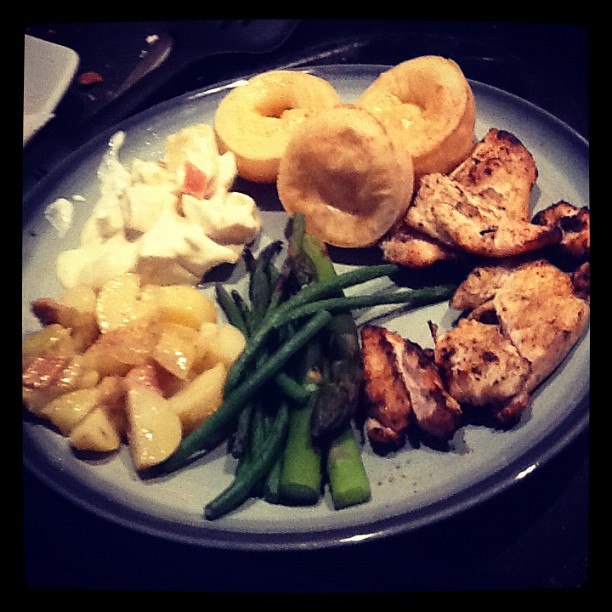
The finished product included Pão de Queijo, grilled blackened chicken, smoked sausage hot dogs, grilled green beans and asparagus, and both German and American potato salad. It took too long to make, but it was so worth it! Check out the recipes linked below, and recreate our cookout for your own summer days, whether they be often or twice a year.
Pão de Queijo
German and American potato salad
Grilled green beans and asparagus (posted soon!)
Wednesday, May 23, 2012
Pão de Queijo (Brazilian cheese breads)
When I first became gluten-free, my aunt passed this recipe on to me. Her boyfriend is from Brazil, and he recommended it as a gluten-free recipe (requiring no substitutions, which I find so useful). It was so impressive, I tried several combinations of flavours. Try various types of soft cheeses and throw in your favourite herbs and spices. It's quick and easy -- especially if you have a blender -- and is a tasty snack.
Other additions that have been successful are cayenne; garlic powder and basil; cracked black pepper. Let me know if you try something new and like it! Also, if you'd like to make multiple flavours at once (and/or like a bit more rustic appearance), sprinkle your chosen spice/herb directly atop the batter once poured into the muffin tins. It looks lovely and lets you tell the difference between the different kinds.
The final breads will puff up in the oven and fall once they begin to cool. The centers will be chewy but should still be light. If the centers are heavy, let them bake for a few more minutes, watching carefully to prevent burning the thin tops.
Ingredients:
1 egg, room temperature
1/3 cup olive oil
2/3 cup milk
1 1/2 cups (170 grams) tapioca flour
1/2 cup packed (about 66 grams) grated fresh mozzarella cheese
1 1/2 teaspoon salt
2 teaspoon smoked paprika
1 teaspoon garlic powder
sunflower oil spray or other greasing oil
Hardware:
medium mixing bowl (or blender)
wooden spoon (if no blender)
measuring cups and spoons
flexible spatula
large spoon or ladle
muffin tins
oven
Directions:
Preheat the oven to 400°F/200°C.
If you have a blender, the directions are incredibly easy. Add all ingredients, minus the sunflower oil, into the blender in the following order: milk, egg, flour, cheese, salt, paprika, garlic powder, olive oil. I include this order because it has liquid on top and bottom, encouraging the entire mixture to properly circulate through the blender. Blend until combined, stopping to scrap the sides with the spatula to ensure a proper mix.
Grease muffin tins, and pour the mixture evenly to just above the middle of each cup. It should make approximately 18 small breads. Bake for about 18 minutes, until breads have risen and are slightly browned on top.
If you don't have a blender, I hope you have a strong mixing arm! Add the ingredients to the mixing bowl in the following order: milk, egg, olive oil, cheese, salt, paprika, garlic powder, flour. The reason I include this order is because, otherwise, you will likely have a gluey substance in your bowl! It will still take swift and heavy stirring to thoroughly combine, and the job will be made easier based on how finely your cheese is grated. Stir until you are sure it is completely combined, scraping the sides with the spatula when necessary.
Grease muffin tins, and spoon/ladle the mixture evenly to just above the middle of each cup. It should make approximately 18 small breads. Bake for about 18 minutes, until breads have risen and are slightly browned on top.
Labels:
bread,
cheese,
eggs,
gluten-free,
snack,
tapioca,
vegetarian
Subscribe to:
Posts (Atom)